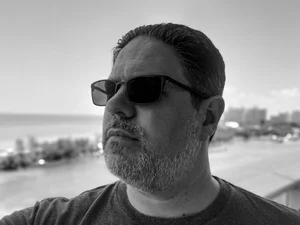
N.Y. Fed President John C. Williams discusses economic resilience
John C. Williams, President and Chief Executive Officer of the Federal Reserve Bank of New York, discussed the U.S. economy during his visit to the Mount.
Photo by Matt Frey
John C. Williams, President and Chief Executive Officer of the Federal Reserve Bank of New York, discussed economic resilience and community impact during a talk at Mount Saint Mary College in May.
The event, hosted by Hudson Valley Pattern for Progress and its President and CEO, Adam Bosch, focused on the current state of the regional and national economy, the challenges facing local families, and the unique role of community engagement in shaping monetary policy.
The session was held at the Mount campus, highlighted by Bosch for its deep roots in the community. Bosch opened the event by sharing a personal anecdote about attending basketball camps on the campus as a child, noting that “Mount Saint Mary College is a place where the community can connect to itself.”
Williams’ visit to the Hudson Valley was part of his ongoing efforts to gather “beige book” style anecdotal evidence directly from business and community leaders. He emphasized that these on-the-ground insights are a critical component of the Federal Reserve’s decision-making process.
“Part of my job, and part of the job of my team, is really to understand what’s happening in our district,” Williams said. “If I say monetary policy needs to be data dependent, I mean not only the economic data like the unemployment rate or the inflation rate, but all the information that we gather through all of our sources, whether through financial markets…or actually coming out and talking to real people.”
During the discussion, Williams addressed the “K-shaped” nature of the post-pandemic recovery, acknowledging the significant pressure on lower- and moderate-income families due to rising costs in housing, energy, and food. However, he remained optimistic about the broader U.S. economic trajectory.
“We actually saw a U.S. economy that continued to grow and show remarkable resilience,” he said. “Businesses and consumers continued to spend and invest. GDP growth was about 2 percent last year... seems like it’s about the same this year, at least based on what we’ve seen so far.”
Regarding the Federal Reserve’s primary mandate of price stability, Williams highlighted the progress made in curbing the post-pandemic surge in costs.
“The big story is, of course, inflation,” he said. “We were seeing inflation coming down from the very high levels of just a few years ago, down closer to our 2 percent goal…and that’s been interrupted a bit because of the effects of tariffs and now energy prices. So I think right now, we came into this with an economy that’s pretty resilient, driven in significant part by the massive investments in AI data centers. And we’re seeing that here in the region; we’re seeing it everywhere else too.”
Williams said that despite domestic and geopolitical uncertainties, the United States remains a global leader in economic dynamism.
“Everybody in the world looks to the United States in terms of the economy, in the most optimistic way,” he said. “We have the highest levels of productivity, we have the highest expectations of productivity growth... We are the envy of the world about the dynamism of our economy, the ability to adapt to change, and to grow.”
Students network with N.Y. Yankees at stadium event
Faculty and staff, left to right: Kyle Teixeira, Assistant Athletic Director for Strategic Communications and Marketing; Michael L. Fox, J.D., Acting Dean of the School of Business and associate professor of Business Law; Brooke Yerger, assistant professor of Sports Management; and John Mahon, Senior Specialist for Outreach and Career Development.
Photo provided
Students and faculty recently traded the classroom for the baseball diamond, attending an exclusive networking and career development event hosted by the New York Yankees.
The event, held at Yankee Stadium, provided a unique bridge between academic study and professional sports management. The program allowed students to engage directly with industry executives and successful Mount alumni currently established within the Yankees organization.
The afternoon began in the main lobby before moving to a luxury suite for an in-depth panel discussion and Q&A session. Students gained firsthand insights into summer sales positions, internship requirements, and long-term career paths within professional athletics.
Representing the Yankees were Stewart Azor, manager of Inside Sales with the ballclub, and two distinguished Mount alumni: Kristen Renta, Specialist of Premium Sales and Service (holding both a BS and MBA from the Mount’s School of Business) and Andrew Connors, Account Executive of Group Sales and Service.
“It was a wonderful program that we hope will be fruitful in building a further relationship between the Mount and the New York Yankees for the benefit of our students,” said Brooke Yerger, assistant professor of Sports Management.
The experience concluded with the group watching the Yankees take on the Kansas City Royals from Suite #8.
The trip was made possible through the support of the School of Business Go Blue Experiential Education Fund, which covered transportation costs thanks to the contributions of generous donors.
In addition to Yerger, faculty and staff in attendance included John Mahon, Senior Specialist for Outreach and Career Development; Kyle Teixeira, Assistant Athletic Director for Strategic Communications and Marketing; and Michael L. Fox, J.D., Acting Dean of the School of Business and associate professor of Business Law.
From Satanist to Saint: Mount lecture delves into newly canonized tertiaries, Longo and Frassati
Robert Miller, associate professor of Religious Studies at Mount Saint Mary College, presents “Climbing Mountains and Dodging Demons: The Dangerous Faith of Frassati and Longo.”
Photo by Matt Frey
If a reformed satanic priest turned lawyer and a mountain climber who hid his faith from his antireligious father can become Catholic saints, anyone can turn their education and passions into a life with real impact.
That was the crux of the talk “Climbing Mountains and Dodging Demons: The Dangerous Faith of Frassati and Longo” by Robert Miller, associate professor of Religious Studies.
The event served as the latest installment of “Lectures in Applied Theology in Honor of Sr. Peggy Murphy.” The series was established in 2024 to honor Sr. Murphy, a founding advisory board member of the Catholic and Dominican Institute who dedicated more than 20 years to teaching world religions at the college.
Miller’s presentation focused on the lives of Bartolo Longo and Pier Giorgio Frassati, two Dominican tertiaries (lay members) who were canonized by Pope Leo XIV just last year.
Their stories demonstrate how holiness is accessible to ordinary people, regardless of their background: “No matter what your life situation is, you too could become a saint,” Miller said.
Longo is a fascinating case study in redemption. Born and raised a Catholic, he drifted into the occult during his university years in Naples, a reaction to his parents’ untimely deaths. It led him down a dark path, with Longo eventually becoming a follower of Satan.
But this created a life wrought with despair and anxiety, Miller explained. What finally brought Longo lasting peace and purpose was his return to God though the Dominican order, as well as a renewed devotion to the Rosary.
Longo eventually used his legal education to become a devoted community leader and advocate for the marginalized in Pompeii, earning two nominations for the Nobel Peace Prize in 1902 and 1903.
While Longo’s struggles came mostly from within, Frassati’s were largely with society and family. Born into a wealthy, influential family in Turin in 1901, Frassati was a champion athlete and mountain climber who frequently used his social life to draw others toward faith.
After Frassati’s death from polio at age 24, his friends remarked, “Our parents couldn’t get us to go to mass, our priest couldn’t get us to go to mass, but Per Giorgio got us to go.”
Frassati’s final act was one of service. He asked his sister to take a prescription from his jacket to help a local man in need. His final written words were a testament to his mission: “Here are the injections for the poor man Converso... please renew the prescription and charge it to my account at the bank.”